Is Being Gay a Choice? What Science Says About Sexual Orientation
Is being gay a choice? Explore what science says about sexual orientation, genetics, development, sexual fluidity, and the difference between attraction and behavior.
By Adrian Solen · Published July 31, 2026 · Approximately 7 minutes
Is being gay a choice?
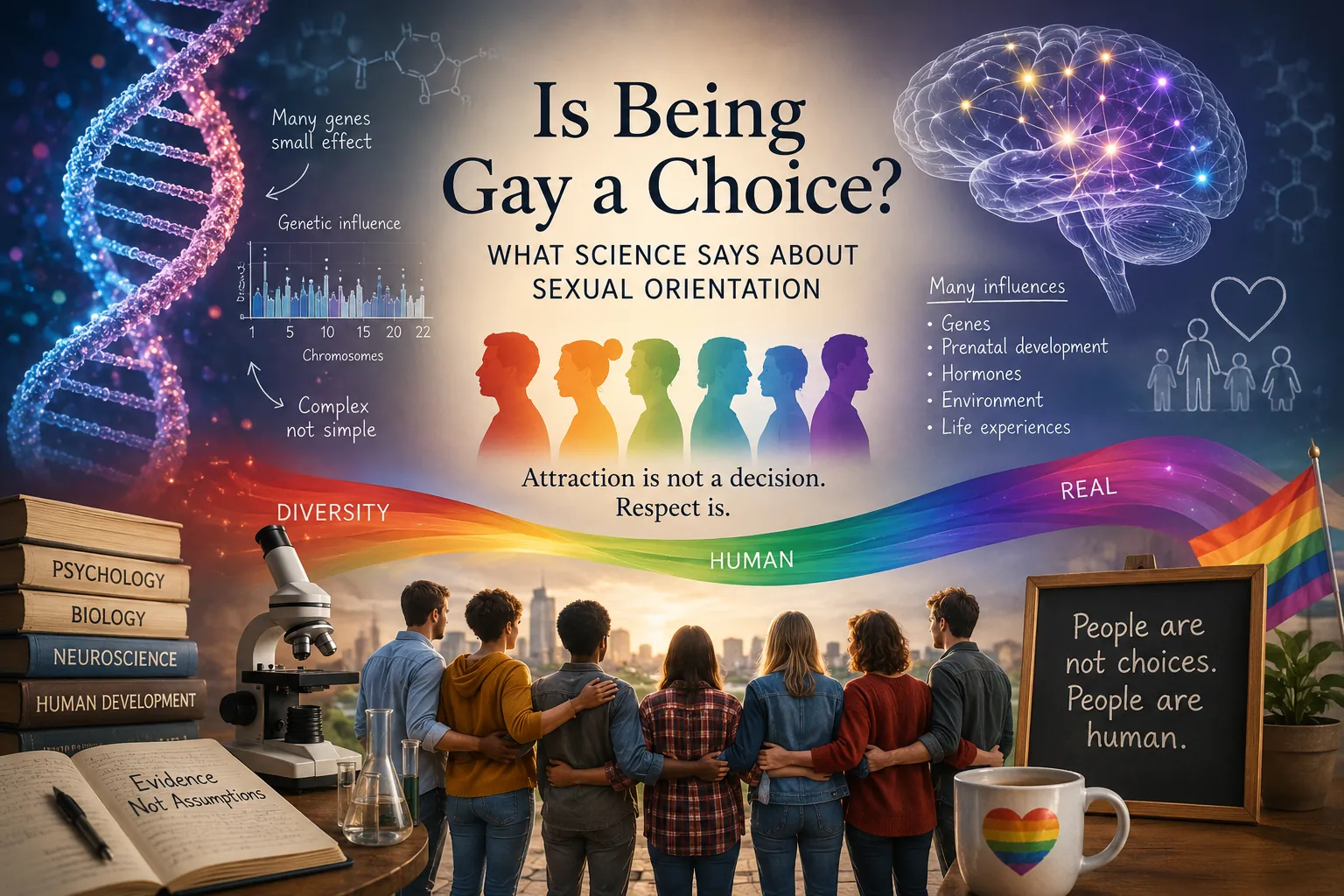 The clearest answer supported by modern psychological and scientific evidence is no: people do not ordinarily choose the pattern of romantic or sexual attraction they experience.
People can make choices about relationships, sexual behaviour, disclosure, labels, marriage, celibacy, and how openly they live. But those decisions are not the same as choosing which people they are capable of finding emotionally, romantically, or sexually attractive.
The American Psychological Association describes sexual orientation as an enduring pattern of emotional, romantic, or sexual attraction. It also reports that most people experience little or no sense of choice concerning their sexual orientation.
That does not mean science has discovered one simple cause of sexual orientation. There is no single “gay gene,” no parenting style that has been shown to create an orientation, and no universal life event that explains why one person is straight, gay, lesbian, bisexual, asexual, or identifies in another way.
The evidence instead points toward a complex human characteristic shaped through multiple biological and developmental influences.
What Is Sexual Orientation?
Sexual orientation describes a person’s enduring pattern of romantic, emotional, or sexual attraction.
Common sexual orientations include heterosexual or straight, gay, lesbian, bisexual, and asexual. Some people use terms such as pansexual, queer, or another label that better describes their experience. Others prefer not to use a label at all.
Researchers often examine sexual orientation through three related but distinct dimensions:
- Attraction: whom a person feels romantically or sexually drawn toward.
- Behaviour: whom a person has romantic or sexual experiences with.
- Identity: the word or category a person uses to describe themselves.
These dimensions do not always align perfectly.
Someone may experience same-sex attraction without having had a same-sex relationship. Another person may have had a particular experience without adopting a gay or bisexual identity. A person may also take time to understand or name feelings that existed long before they had words for them.
This distinction is important because attraction, behaviour, and identity are often treated as though they are interchangeable. Scientifically and personally, they are not always the same.
Do People Choose Their Attractions?
Most people do not remember deciding whom they would find attractive.
A heterosexual person generally does not describe sitting down one day and choosing to become attracted to another sex. Similarly, gay, lesbian, and bisexual people commonly report becoming aware of attractions rather than consciously creating them.
A person may choose whether to pursue an attraction. They may choose whether to begin a relationship, disclose their identity, use a particular label, or live according to cultural or religious expectations.
But choosing how to respond to an attraction is different from choosing the attraction itself.
Consider an ordinary example. A person may feel attracted to someone who is unavailable, incompatible, or unsuitable as a partner. They can decide not to act on that attraction, but the decision does not prove that they deliberately created the feeling.
The same distinction applies to sexual orientation.
What Causes Someone to Be Gay?
Science does not currently provide one universal explanation for why a person develops a particular sexual orientation.
Researchers have studied genetics, prenatal development, hormones, family patterns, brain development, birth order, social environment, and many other possible influences.
The most responsible conclusion is not that scientists know nothing. It is that sexual orientation appears to be complex and cannot be reduced to one gene, one childhood experience, one family relationship, or one conscious decision.
Human characteristics are often produced through many interacting influences. Height, personality, temperament, handedness, and vulnerability to certain health conditions can all involve complicated relationships among biology, development, and environment.
Sexual orientation appears to be similarly complex.
Is Being Gay Genetic?
Genetics appears to contribute to same-sex sexual behaviour, but genes do not provide a complete explanation.
A major genome-wide study published in Science in 2019 examined genetic data from hundreds of thousands of people. Researchers found that many genetic variants, each with a very small influence, were associated with same-sex sexual behaviour.
The study did not discover a single gene that makes someone gay.
It also found that genetic information could not meaningfully predict an individual person’s sexual behaviour. The genetic picture was distributed across many parts of the genome and remained only one part of a much larger explanation.
Another important limitation is that the study measured reported same-sex sexual behaviour. Behaviour, attraction, and identity are related, but they are not identical.
The accurate conclusion is therefore:
- Genetic influences appear to play a role.
- There is no single “gay gene.”
- Genes do not determine one inevitable outcome.
- A DNA test cannot reliably determine a person’s sexual orientation.
- Genetics alone cannot explain the full diversity of human sexuality.
Does Biology Mean Destiny?
Saying that biology contributes to a characteristic does not mean that one biological factor determines everything about a person.
Human development is rarely that simple.
Genes may affect how an organism develops, but genes operate within biological systems. Prenatal conditions, hormones, neurological development, and countless interactions among genetic variants may all contribute to later characteristics.
Scientists therefore distinguish between a trait being influenced by biology and a trait being controlled by one biological switch.
Sexual orientation appears to involve biological influence without simple biological determinism.
This distinction also prevents two opposite misunderstandings. The absence of one decisive gene does not prove that sexual orientation is chosen. At the same time, evidence of genetic influence does not mean that every person’s experience follows one identical developmental pathway.
Can Parenting Make a Child Gay?
Research has not established that a particular parenting style causes a child to become gay, lesbian, or bisexual.
Sexual orientation has sometimes been blamed on an absent father, an overprotective mother, childhood friendships, exposure to LGBTQ+ people, media, education, or a failure to follow traditional gender roles.
These explanations have not provided a reliable scientific account of sexual orientation.
Children raised in similar households can develop different orientations. Gay and lesbian people come from conservative, liberal, religious, secular, supportive, rejecting, stable, and unstable families.
Likewise, heterosexual children are raised by many different kinds of parents and within many different cultures.
Parents can influence how safe a child feels discussing identity. Families can affect whether someone hides, accepts, fears, or openly expresses their feelings. That influence is important, but it is different from creating the underlying attraction.
Can Someone Be Influenced Into Becoming Gay?
Learning that LGBTQ+ people exist may give someone language for feelings they already had. It may also make them feel safer acknowledging those feelings.
That increased visibility can produce the impression that education, media, or friendships created the orientation. A more plausible explanation is often that recognition became easier.
For much of history, people had limited vocabulary for describing same-sex attraction. Many also faced criminal punishment, medical condemnation, religious exclusion, family rejection, or loss of employment.
Under those conditions, people frequently hid their lives or described intimate relationships indirectly.
Greater visibility does not necessarily mean that a human experience suddenly appeared. It may mean that more people gained the language and safety required to describe it.
The historical evidence of same-sex love and gender diversity is explored further in Did LGBTQ+ People Exist in Ancient History? What the Evidence Shows.
What Is the Difference Between Choice and Sexual Fluidity?
Some people experience changes in attraction, behaviour, or identity across their lives. Researchers often describe this as sexual fluidity.
Sexual fluidity does not mean that everyone can deliberately change orientation whenever they wish.
A person may discover that an earlier label no longer fully describes them. Someone who once identified as straight may later identify as bisexual. Another person may stop using labels entirely. Attractions may also become clearer as a person gains experience, safety, maturity, or self-understanding.
Change and choice are not the same concept.
A person’s emotional response to grief, love, music, faith, or belonging can change over time without being consciously manufactured. Human experience can be both real and capable of development.
Sexual fluidity also varies. Some people report a highly stable orientation throughout life. Others describe more movement, especially in how they identify or understand their attractions.
Neither experience should automatically be treated as the universal rule for everyone else.
Can People Choose Their Sexual Behaviour?
Yes. People make choices about behaviour, relationships, and personal commitments.
A person can decide whether to date, marry, remain celibate, enter a particular relationship, or follow religious teachings concerning sexual conduct.
Those choices may be deeply meaningful. They can reflect personal ethics, family responsibilities, faith, culture, safety, or individual goals.
However, a person’s behavioural choices do not necessarily reveal the full pattern of their attractions.
A gay person may enter a heterosexual marriage because of social pressure. A bisexual person may have only different-sex partners. A heterosexual person may choose lifelong celibacy. None of those decisions automatically changes the person’s underlying capacity for attraction.
Understanding this difference allows discussions about sexuality to become more precise. It also creates room for conversations between people who hold different moral or religious beliefs without misrepresenting the scientific question.
Can Therapy Change Sexual Orientation?
Professional efforts intended to turn gay or bisexual people heterosexual are commonly called conversion therapy or sexual-orientation change efforts.
Major psychological and health organizations do not consider these practices reliable treatments for changing sexual orientation.
The American Psychological Association has concluded that evidence does not support claims that such efforts can reliably change a person’s enduring attractions. It has also warned that coercive or biased change efforts may be associated with serious psychological harm.
Supportive therapy can still help people work through family conflict, religious questions, relationships, stigma, anxiety, depression, or uncertainty about identity.
The difference is that ethical support does not begin with the assumption that a gay, lesbian, or bisexual orientation is an illness that must be eliminated.
A therapist can help someone explore values and make decisions without promising to manufacture a different orientation.
Is Being Gay a Mental Illness?
No. Gay and lesbian sexual orientations are not classified as mental illnesses.
In 1990, the World Health Assembly stopped classifying homosexuality as a mental disorder within the International Classification of Diseases.
That decision reflected decades of changing medical evidence and professional understanding.
LGBTQ+ people can experience depression, anxiety, trauma, or other mental-health conditions, just as heterosexual people can. But sexual orientation itself is not the disorder.
Research into LGBTQ+ health repeatedly emphasizes the effects of stigma, rejection, discrimination, violence, concealment, and chronic stress. These pressures can damage well-being without making the identity itself pathological.
Confusing social harm with mental illness reverses cause and effect. If someone suffers because they are threatened, rejected, or punished, the suffering does not prove that their orientation is the disease.
Sexual Orientation Is Not the Same as Gender Identity
Sexual orientation concerns the pattern of people toward whom someone experiences romantic or sexual attraction.
Gender identity concerns a person’s internal understanding of their own gender.
They are distinct characteristics.
A transgender person can be straight, gay, lesbian, bisexual, asexual, or another orientation. A cisgender person can also have any sexual orientation.
Combining sexual orientation and gender identity into one concept creates confusion in both scientific and public discussion.
The National Academies describes sex, gender identity, and sexual orientation as interrelated but conceptually distinct and multidimensional constructs.
Why Did People Once Treat Homosexuality as a Crime or Disease?
Scientific classifications do not develop in isolation from culture.
For centuries, religious teachings, legal traditions, gender expectations, colonial systems, and social fears shaped the way same-sex relationships were interpreted.
In some periods, governments punished particular sexual acts as crimes. Later, doctors and psychiatrists increasingly classified certain desires and identities as medical abnormalities.
A person could therefore move from being described as a sinner, to a criminal, to a patient—sometimes while experiencing all three forms of condemnation at once.
The prosecution of Alan Turing demonstrates what happened when law, morality, national security, and medical authority converged around one person’s private life.
Read more in Why Was Alan Turing Prosecuted for Homosexuality?.
The broader development of criminal laws is examined in When Did Homosexuality Become Illegal? The History Behind LGBTQ+ Criminalization.
What Science Can—and Cannot—Decide
Science can investigate how sexuality develops, how attractions are experienced, how identities are measured, and whether proposed treatments produce reliable outcomes.
Science can also test claims. It can ask whether one gene determines orientation, whether a parenting style creates it, or whether a therapy reliably changes it.
But science alone cannot settle every moral, philosophical, cultural, or religious question.
It cannot tell a family what tradition must mean to them. It cannot decide how every faith community should interpret scripture. It cannot produce one political position that all people are required to hold.
What science can require is intellectual honesty.
People may disagree about relationships, marriage, religious doctrine, education, or social policy. But disagreement becomes less constructive when it depends on inaccurate claims about what people choose, what medicine classifies as illness, or what research has actually discovered.
Understanding evidence does not force everyone into identical beliefs. It creates a more truthful foundation from which difficult conversations can begin.
Why the Question “Is Being Gay a Choice?” Matters
The question is not merely theoretical.
For many people, the answer influences how they treat a child, sibling, student, employee, neighbour, or member of a religious community.
If sexual orientation is imagined as a casual decision, rejection may be presented as motivation to make a different choice. Punishment may be portrayed as correction. Shame may be described as treatment.
But when attraction is understood as a deeply rooted aspect of human experience, the moral responsibility shifts.
The question becomes less about forcing someone to become different and more about how people with different identities, values, and traditions can live together without cruelty or dishonesty.
From Scientific Evidence to Human Understanding
The history of sexuality shows that facts alone do not automatically resolve cultural conflict.
People interpret evidence through family histories, religion, politics, fear, personal experience, and the desire to protect a familiar understanding of the world.
That is why productive discussion requires more than repeating that science has spoken. It requires explaining what research actually shows, acknowledging what remains uncertain, and recognizing the human concerns on every side.
A compassionate conversation does not need to pretend that every question has a simple answer.
It does need to separate attraction from behaviour, identity from pathology, scientific uncertainty from deliberate choice, and disagreement from dehumanization.
Explore the Science, History, and Human Story of Identity
The Clash of Rainbows and Traditions: The Human Story of Sexuality and Gender Diversity by Adrian Solen examines these questions through history, science, religion, law, culture, and personal experience.
The book does not reduce sexuality and gender to political slogans. It explores how identities develop, how societies define normality, why traditions resist change, and what happens when private human lives become subjects of public conflict.
Its purpose is not to attack religious people or dismiss LGBTQ+ experience. It is to create a more informed conversation between communities that too often speak about one another without understanding one another.
Discover The Clash of Rainbows and Traditions and explore the deeper history and science behind sexuality, gender, identity, tradition, and human belonging.
Frequently Asked Questions
Is being gay a choice?
People can choose their behaviour, relationships, labels, and how openly they live, but most people do not experience their underlying pattern of attraction as a conscious choice.
Is homosexuality genetic?
Genetics appears to contribute to same-sex sexual behaviour, but there is no single gene that determines whether someone is gay. Research points toward many genetic influences interacting with broader biological and developmental factors.
Is there a gay gene?
No single “gay gene” has been identified. Large genetic studies indicate that many genetic variants may each contribute a very small influence, but they cannot reliably predict an individual’s sexual orientation.
Can parenting cause a child to become gay?
No particular parenting style has been established as the cause of a gay, lesbian, or bisexual orientation. Parents can influence whether children feel safe discussing their identity, but that is different from creating their attractions.
Can someone choose not to act on same-sex attraction?
Yes. People can make decisions about sexual behaviour, relationships, celibacy, and religious commitments. Choosing not to act on an attraction does not necessarily eliminate or change the attraction itself.
Can sexual orientation change over time?
Some people report changes in attraction, behaviour, or identity over time, while others experience a highly stable orientation. Such fluidity is not the same as being able to deliberately choose or therapeutically manufacture a different orientation.
Can conversion therapy make a gay person straight?
Reliable evidence does not show that conversion therapy can consistently change enduring sexual orientation. Major psychological organizations oppose coercive or biased change efforts and warn about their potential for harm.
Is being gay a mental disorder?
No. Gay and lesbian sexual orientations are not classified as mental disorders. The World Health Assembly stopped classifying homosexuality as a mental disorder in 1990.
What is the difference between sexual orientation and gender identity?
Sexual orientation concerns whom a person is attracted to. Gender identity concerns a person’s understanding of their own gender. A transgender or cisgender person can have any sexual orientation.
Research Sources
- American Psychological Association: Understanding Sexual Orientation
- Science: Large-Scale Genetic Study of Same-Sex Sexual Behaviour
- National Academies: Measuring Sex, Gender Identity, and Sexual Orientation
- American Psychological Association Resolution on Sexual-Orientation Change Efforts
- World Health Organization: Changes to International Health Classification
No public comments yet
Be the first to share a thoughtful note. Approved comments will appear here.