Did LGBTQ+ People Exist in Ancient History? What the Evidence Shows
Did LGBTQ+ people exist in ancient history? Explore evidence of same-sex love, gender diversity, and identities that existed long before modern terminology.
By Adrian Solen · Published July 27, 2026 · Approximately 5 minutes
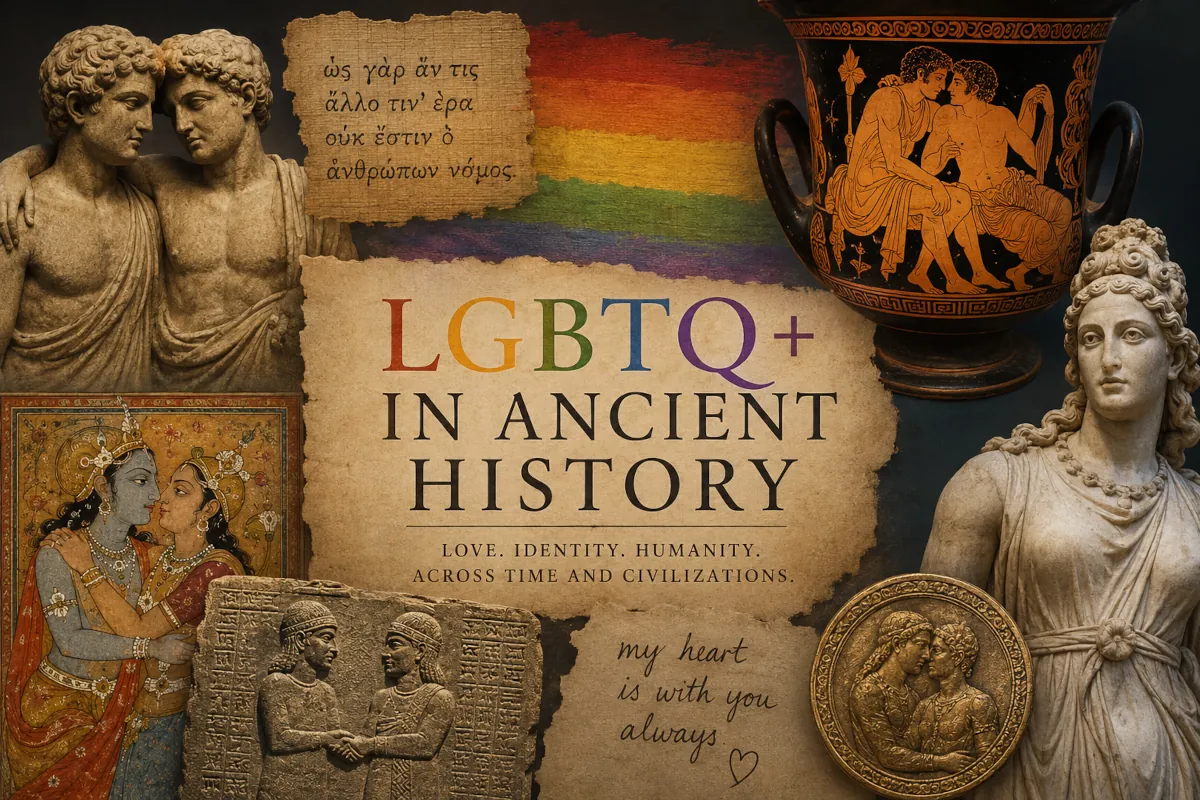
Did LGBTQ+ people exist in ancient history?
The question sounds simple, but the most accurate answer requires both honesty and historical care.
Same-sex desire, intimate relationships between people of the same gender, and lives that crossed expected gender boundaries existed long before the modern world. They appear in ancient poetry, mythology, art, religious traditions, legal records, personal correspondence, and historical accounts.
However, people in ancient societies did not usually describe themselves with words such as gay, lesbian, bisexual, transgender, or LGBTQ+. Those are modern identity terms created within very different cultural and political circumstances.
Ancient LGBTQ+ history is therefore not about placing modern labels on every person from the past. It is about recognizing that human sexuality and gender have always been more complex than a single social model.
The Honest Answer: Yes, but the Words Were Different
If we use LGBTQ+ as a broad modern description for people who experienced same-sex attraction, formed same-sex relationships, or lived outside the gender expectations of their societies, then LGBTQ+ people have existed throughout recorded history.
What changed over time was not the existence of human diversity. What changed were the words, laws, religious interpretations, social categories, and identities used to understand it.
The terms homosexual and heterosexual, for example, were not coined until the nineteenth century. Earlier societies generally did not divide every person into fixed sexual-orientation categories in the way many people do today.
An ancient man might have relationships with both women and men without describing himself as bisexual. A woman could write passionately about another woman without using the word lesbian. A person might live in a religious or social role that crossed ordinary gender boundaries without identifying as transgender or non-binary.
The experiences were real. The modern vocabulary came much later.
Why Modern LGBTQ+ Labels Do Not Fit Ancient History Perfectly
Modern LGBTQ+ identities often describe a person’s enduring sense of sexual orientation or gender identity. In many ancient cultures, sexuality was categorized differently.
Social status, age, citizenship, family role, gender expectations, and position within a relationship could matter more than the gender of a person’s partner.
This is especially important when discussing ancient Greece and Rome. These societies were not simply modern LGBTQ-friendly cultures transported into the past. They had their own rules, inequalities, expectations, and restrictions.
Some same-sex relationships were accepted under particular circumstances while others were condemned. Certain forms of gender difference could have religious meaning, while people who challenged other gender expectations might face ridicule or punishment.
History rarely offers a clean division between acceptance and rejection.
Recognizing ancient sexual and gender diversity does not require romanticizing ancient societies. It requires understanding them on their own terms.
Same-Sex Love in Ancient Greek History
Ancient Greece is frequently discussed in the history of homosexuality because its literature, philosophy, art, and mythology contain many references to relationships and desire between people of the same sex.
Yet there was no single Greek position on sexuality. Ancient Greece consisted of different city-states with different customs, laws, and social expectations.
Relationships between males were known in several Greek societies, but they were often shaped by age, education, citizenship, masculinity, and social rank. These arrangements were not necessarily based on the modern idea of two equal adults forming a shared gay identity.
Greek mythology also contains stories involving same-sex affection and desire. Figures such as Zeus, Apollo, Achilles, Patroclus, and Hyacinthus later became important in discussions about sexuality, companionship, grief, and love.
Women’s experiences are more difficult to reconstruct because most surviving ancient records were created or preserved by men. One of the most important exceptions is Sappho, the poet associated with the island of Lesbos.
Sappho’s surviving poetry includes powerful expressions of affection and desire directed toward women. Her name and birthplace eventually influenced the development of the words Sapphic and lesbian.
We should still be cautious about assigning Sappho a modern identity based on fragmentary poetry written more than two thousand years ago. But her work remains powerful evidence that desire between women is not a modern invention.
Sexuality and Social Status in Ancient Rome
Ancient Roman society also recognized sexual relationships involving people of the same sex, but Romans did not generally organize sexuality around a simple heterosexual-versus-homosexual division.
For Roman men, citizenship, status, masculinity, and the role a person occupied within a sexual relationship could be more socially important than the gender of the partner.
A free Roman man could express desire toward women or men without automatically being placed into a fixed identity category. However, Roman sexual customs were deeply unequal. Enslaved people, young people, foreigners, and those with less social power could be vulnerable to exploitation.
This distinction matters because historical visibility does not always mean equality.
Ancient Rome provides evidence of same-sex attraction and relationships, but it should not be presented as a society that understood consent, partnership, identity, or human rights in the same way many people do today.
Gender Diversity Beyond Greece and Rome
Ancient LGBTQ+ history should not be limited to Europe.
Across different cultures, historical records describe deities who changed gender, figures who combined masculine and feminine characteristics, religious specialists who lived outside ordinary gender roles, and communities with social categories that did not fit a strict male-female division.
Ancient Mesopotamian religious literature includes figures and ritual roles that have led scholars to examine how gender difference was understood in some of the world’s earliest recorded civilizations.
South Asian mythology and religious art also contain stories of gender transformation, combined genders, and movement between masculine and feminine forms. These traditions developed within their own spiritual and cultural frameworks and should not be reduced to modern Western labels.
Other societies across Africa, Asia, the Pacific, and the Americas developed their own ways of understanding sexuality, kinship, gender, family responsibility, and community roles.
There was never one universal ancient attitude toward sexual or gender diversity. Human cultures produced many different systems—some accepting, some restrictive, and many containing both possibilities at once.
Was Homosexuality Accepted in Ancient Civilizations?
There is no single answer because ancient civilizations were not all the same.
Even within one society, attitudes could change according to the historical period, location, social class, gender, religious authority, or political leadership.
Some cultures permitted specific forms of same-sex intimacy while rejecting others. Some celebrated gender transformation in mythology while enforcing strict gender expectations in ordinary life. Some tolerated private behaviour but punished public challenges to family or social order.
This is why statements such as “the ancient world accepted homosexuality” or “all traditional societies rejected it” are both historically misleading.
The reality was far more complicated.
History is not a straight line that moves steadily from tolerance to persecution or from ignorance to acceptance. Societies can become more open in one period and more restrictive in another. Laws can change while prejudice remains. Religious interpretations can harden, soften, divide, or evolve.
Why So Much LGBTQ+ History Was Hidden
Many LGBTQ+ histories are difficult to recover because the people involved did not have the freedom to describe their lives openly.
Some evidence was destroyed. Some was never recorded. Some relationships were hidden behind words such as friend, companion, favourite, or roommate. Other lives survive mainly through criminal trials, medical files, religious condemnations, or hostile accounts written by opponents.
Historians must therefore interpret incomplete records carefully.
Silence does not prove that same-sex love or gender diversity was absent. At the same time, ambiguous evidence should not be treated as absolute proof of a modern identity.
Responsible LGBTQ+ history must avoid two opposite mistakes: erasing human diversity from the past and forcing present-day categories onto people who understood themselves differently.
LGBTQ+ History Is Human History
Learning about LGBTQ+ history does more than settle an argument about whether certain identities are “new.”
It reveals how societies define belonging. It shows how family structures, religious beliefs, political power, scientific theories, laws, and cultural fears shape the way people understand one another.
It also reminds us that people from the past were not symbols in a modern political debate. They were human beings who experienced affection, desire, loyalty, shame, courage, fear, companionship, loss, and hope.
Their words may have been different from ours, but many of their emotional experiences remain recognizable.
Studying this history does not demand that every reader reach the same conclusion about every modern issue. It asks something more basic: that we begin with evidence rather than assumptions and with curiosity rather than hostility.
From Ancient History to the Modern LGBTQ+ Experience
The modern LGBTQ+ community did not appear suddenly in the twentieth century.
Modern identities and political movements developed gradually as older experiences of desire and gender difference met new developments in medicine, psychology, law, religion, urban life, publishing, and human-rights activism.
Words gave people new ways to understand themselves. Communities formed around shared experiences. At the same time, governments and medical institutions used some of those same categories to monitor, diagnose, criminalize, or punish people.
The story is therefore not only about identity. It is also about power: who is permitted to define what is normal, which lives are recognized, and whose experiences are erased.
Explore the Wider History of Sexuality and Gender
The Clash of Rainbows and Traditions: The Human Story of Sexuality and Gender Diversity by Adrian Solen explores this larger human history.
The book travels across civilizations, religious traditions, scientific developments, cultural conflicts, legal systems, and personal experiences to examine how ideas about sexuality and gender were formed.
It does not present history as a weapon against one side or another. Its purpose is to replace slogans with context and hostility with a more informed conversation.
Understanding does not always require agreement. But meaningful agreement—or meaningful disagreement—is impossible without first understanding the history.
Discover The Clash of Rainbows and Traditions and explore the complex history behind sexuality, gender, identity, tradition, and belonging.
Frequently Asked Questions
Did gay people exist in ancient Greece?
Ancient Greek records clearly describe same-sex desire and relationships. However, Greeks did not usually classify people as gay or straight in the modern sense. Relationships were understood through the social rules of each city-state, including age, status, citizenship, and gender expectations.
Did ancient Rome accept homosexuality?
Roman society permitted some same-sex relationships, but acceptance depended heavily on status and social role. Romans did not use modern sexual-orientation categories, and their society was unequal in ways that should not be confused with modern LGBTQ+ equality.
Is LGBTQ+ identity a modern invention?
Modern LGBTQ+ terminology and political identities are relatively recent. The underlying experiences—including same-sex attraction, same-sex relationships, and gender diversity—are documented throughout history.
Why is ancient LGBTQ+ history important?
It challenges the belief that sexual and gender diversity suddenly appeared in modern society. It also helps readers understand how cultures, laws, religions, and systems of power have shaped attitudes toward identity across different historical periods.
No public comments yet
Be the first to share a thoughtful note. Approved comments will appear here.