Books About Gender Identity and Sexuality for Adults: Where to Start
Looking for books about gender identity and sexuality for adults? Discover where to start with LGBTQ+ history, gender studies, science, culture, law, and human identity.
By Adrian Solen · Published August 20, 2026 · Approximately 5 minutes
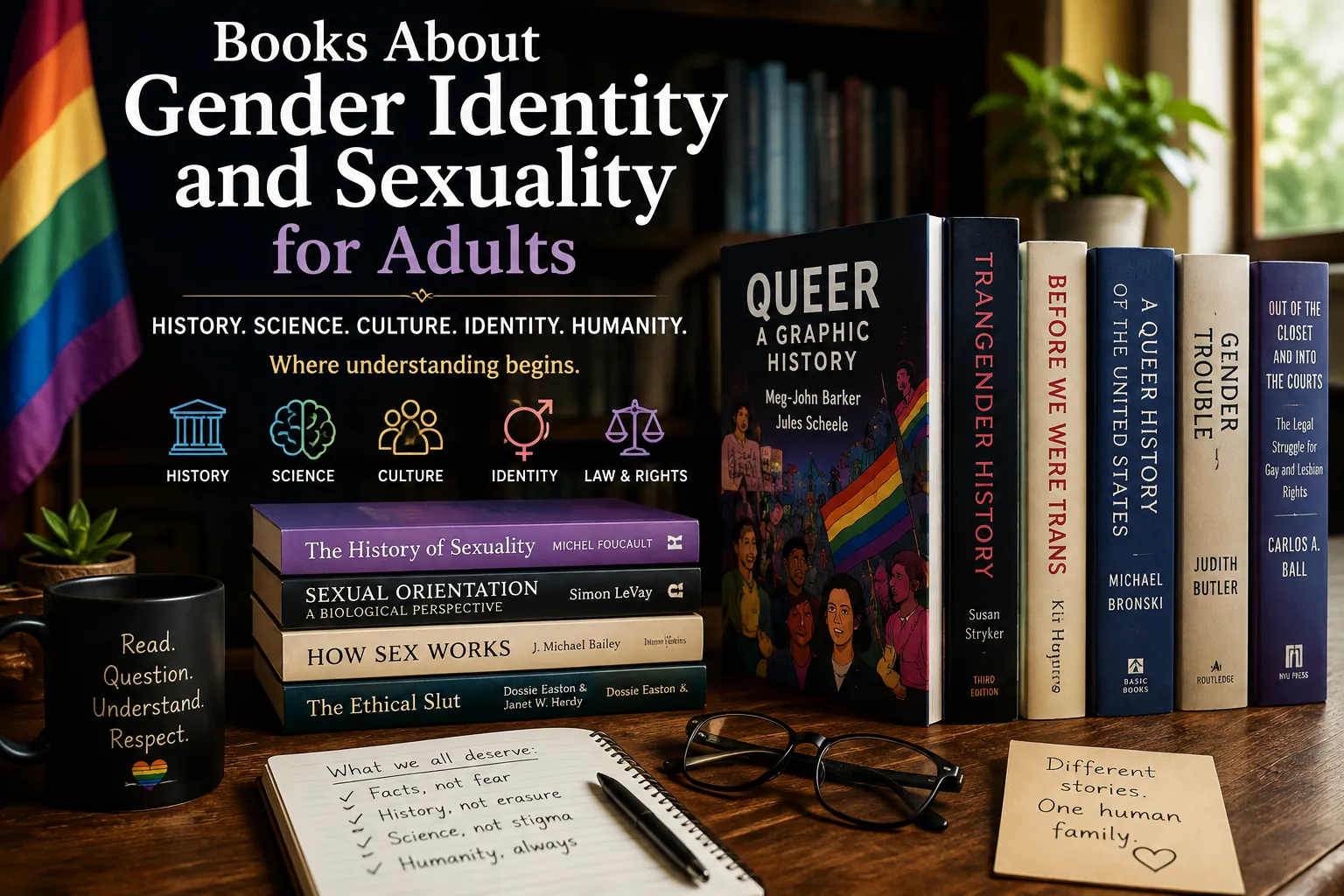 Finding good books about gender identity and sexuality for adults can be surprisingly difficult.
Some books focus almost entirely on LGBTQ+ history. Others concentrate on gender theory, transgender experiences, sexual orientation, psychology, politics, religion, or personal memoir. Academic books can be valuable but intimidating. Popular books may be accessible but sometimes leave out the historical context that explains how modern debates developed.
So where should an adult reader start?
The answer depends on what you actually want to understand.
If your goal is more than learning terminology—if you want to understand how sexuality, gender identity, history, culture, science, religion, law, and human experience connect—then choosing the right starting book matters.
What Are You Trying to Understand?
Before choosing a book about gender or sexuality, it helps to ask what brought you to the subject.
You might be:
- trying to understand LGBTQ+ history;
- learning about gender identity for the first time;
- looking for a gender studies book that is accessible to beginners;
- trying to understand a gay, lesbian, bisexual, or transgender family member;
- interested in what science says about sexual orientation;
- curious about sexuality in ancient civilizations;
- trying to understand the relationship between religion and LGBTQ+ identities;
- studying the history of laws against homosexuality;
- or simply looking for thoughtful LGBTQ+ nonfiction written for adults.
Those are related questions, but they are not identical.
No single academic discipline owns the subject. History explains how societies changed. Psychology and biology investigate human development. Sociology examines institutions and social expectations. Religious studies explores belief and interpretation. Law reveals how governments turned moral ideas into rules and punishments.
The most useful reading often begins by understanding how these areas interact.
Books About Gender Identity Are Not All the Same
The phrase gender identity books covers an enormous range of material.
Some books are personal memoirs. They tell the story of one person's experience of gender and can help readers understand the emotional and human side of identity.
Others are historical works examining how different societies understood gender expression, gender roles, or people who lived outside conventional expectations.
Gender studies books approach the subject more theoretically, asking questions such as:
- What is gender?
- How much of gender is biological?
- How much is social or cultural?
- What is the difference between sex and gender?
- How have ideas about masculinity and femininity changed?
- Why do different cultures recognize different gender roles?
There are also books focused specifically on transgender history and contemporary transgender experience.
Susan Stryker's Transgender History, for example, has become an important introduction to transgender history in the United States. Kit Heyam's Before We Were Trans takes a more global historical approach, examining people and cultures whose experiences of gender did not always fit neatly into modern categories.
These books demonstrate why understanding gender requires more than memorizing a list of modern terms.
Books About Sexuality Ask a Different Set of Questions
Sexual orientation and gender identity are often discussed together under the LGBTQ+ umbrella, but they describe different aspects of human experience.
Books about sexuality may examine attraction, relationships, sexual orientation, social attitudes, scientific research, religious morality, or legal regulation.
They may ask questions such as:
- Why are some people gay, lesbian, bisexual, or straight?
- Is sexual orientation chosen?
- How have societies defined acceptable sexuality?
- Were same-sex relationships known in ancient civilizations?
- When did governments begin criminalizing same-sex relationships?
- Why did medicine once classify homosexuality as a disorder?
- How have religion and culture influenced attitudes toward sexuality?
These questions cannot be answered responsibly by looking at only one moment in modern politics.
Sexuality has a history.
If You Want LGBTQ+ History, Start With Context
History is one of the best entry points for adults trying to understand modern LGBTQ+ debates because it reveals how much the language and social rules surrounding sexuality have changed.
Modern words such as gay, lesbian, bisexual, and transgender did not always exist in their present meanings.
That does not mean same-sex attraction or gender diversity suddenly appeared when modern terminology developed.
Historical records show same-sex relationships, gender variance, changing gender roles, and different social categories across many civilizations. But ancient societies did not necessarily understand those experiences in the same way modern Western societies do.
This is why good LGBTQ+ history avoids two extremes.
It should not erase sexual and gender diversity from the past. But it should also avoid casually assigning twenty-first-century identities to people who lived within very different cultural systems.
If this is the area that interests you most, see our guide LGBTQ+ History Books for Adults: Where to Start.
You can also explore Did LGBTQ+ People Exist in Ancient History? What the Evidence Shows for a closer look at the ancient world.
Some Books Focus on One Country or One Community
Specialized books are extremely useful once you know which part of the subject interests you.
Michael Bronski's A Queer History of the United States, for example, concentrates on LGBTQ+ history within the United States.
Susan Stryker's Transgender History concentrates primarily on transgender history and political movements.
Kit Heyam's Before We Were Trans looks across cultures and historical periods at people whose relationships with gender complicate modern categories.
Meg-John Barker and Jules Scheele's Queer: A Graphic History takes another approach, using an illustrated format to introduce queer theory and the ideas that influenced modern understandings of gender and sexuality.
Each is valuable because it answers a particular kind of question.
But a reader who wants the larger picture may eventually need to move between several disciplines.
What About Gender Studies Books for Beginners?
Many people searching for gender studies books for beginners encounter a problem immediately: some of the most influential books in the field were written primarily for academic audiences.
That can make the subject appear more inaccessible than it needs to be.
Judith Butler's Gender Trouble, for example, is enormously influential in gender and queer theory, but it is not necessarily the easiest first introduction for a general reader.
There is nothing wrong with beginning somewhere more accessible.
A good introductory book should help you understand the questions before asking you to master the academic arguments surrounding them.
Start with:
- clear definitions;
- historical context;
- real examples;
- scientific evidence where appropriate;
- multiple cultural perspectives;
- and an explanation of why reasonable people sometimes interpret the same subjects differently.
Once you understand that foundation, academic gender theory becomes much easier to place in context.
History Explains Why Today's Arguments Feel So Intense
Modern disagreements about sexuality and gender did not emerge from nowhere.
For centuries, governments, religions, medical institutions, families, and communities have tried to define acceptable relationships and gender behaviour.
Sometimes those rules remained social expectations. At other times they became criminal laws.
Britain's history provides a striking example. Laws that criminalized sexual activity between men eventually contributed to prosecutions such as that of mathematician and wartime codebreaker Alan Turing.
Turing helped his country during the Second World War, yet in 1952 he was prosecuted because of a consensual relationship with another man.
His life shows why LGBTQ+ history is not merely a story about terminology or identity politics. Laws and cultural attitudes affected actual careers, families, relationships, reputations, and lives.
Read Why Was Alan Turing Prosecuted for Homosexuality? for the full historical context.
Our article When Did Homosexuality Become Illegal? The History Behind LGBTQ+ Criminalization examines how these legal systems developed more broadly.
Why Cross-Cultural Books Matter
Another limitation of some books about gender and sexuality is that they focus almost entirely on modern North America or Western Europe.
Those histories matter, but they are not the whole human story.
Ideas about gender, sexuality, family, masculinity, femininity, marriage, and social roles developed differently across civilizations.
Ancient Greece cannot simply be treated as modern America in sandals. Ancient Rome had different assumptions again. South Asian traditions developed within their own religious and cultural frameworks. Indigenous societies created categories and community roles shaped by their own histories.
Islamic civilizations, Christian Europe, the Ottoman world, China, Japan, Africa, and the Americas each produced different relationships between sexuality, gender, law, religion, family, and social authority.
Studying those differences helps prevent one of the biggest mistakes in discussions about identity: assuming that today's categories are either completely new or completely universal.
History is usually more complicated than either claim.
Science Is Important, but It Cannot Answer Every Question
Modern science adds another essential part of the picture.
Researchers have investigated sexual orientation, genetics, prenatal development, psychology, gender development, and human behaviour.
Scientific research can test factual claims about how people develop and whether particular theories are supported by evidence.
But science cannot decide every moral or religious question for society.
A laboratory cannot determine what a religious tradition must teach. A historical document cannot settle every modern political disagreement. A personal story cannot describe the experience of every LGBTQ+ person.
That is exactly why books that bring several kinds of evidence together can be useful.
The reader can distinguish between questions of historical fact, scientific evidence, religious belief, cultural tradition, personal experience, and public policy rather than treating them all as the same argument.
A Book for Readers Who Want the Bigger Picture
If you are looking for one book that moves across LGBTQ+ history, sexuality, gender identity, science, culture, religion, law, and human experience, The Clash of Rainbows and Traditions: The Human Story of Sexuality and Gender Diversity by Adrian Solen was written for that broader kind of reader.
Rather than treating sexuality and gender as subjects that began with today's political debates, the book follows their much longer human history.
It moves through ancient civilizations and cultural traditions, examines changing religious and legal attitudes, explores scientific research into sexuality and identity, and follows the development of modern LGBTQ+ communities and conflicts.
Just as importantly, the book does not begin with the assumption that understanding requires everyone to reach exactly the same moral, religious, or political conclusions.
Its purpose is to make the conversation more informed.
That makes it particularly suitable for adults who are curious about LGBTQ+ subjects but do not necessarily want either a highly technical academic textbook or a political manifesto.
Explore The Clash of Rainbows and Traditions.
Who Might Benefit From a Book Like This?
Books about sexuality and gender are not only for people studying gender studies at university.
They can be valuable for:
- parents trying to understand a child or adult family member;
- partners and spouses;
- teachers and educators;
- religious readers trying to understand a difficult cultural debate;
- LGBTQ+ readers interested in the history behind modern identities;
- straight readers who simply want to understand the subject better;
- students beginning research in gender or sexuality studies;
- and readers interested in history, sociology, psychology, religion, or human rights.
You do not need to belong to a particular community to want to understand its history.
How to Choose a Good Book About Gender and Sexuality
Before buying a book, look beyond the title and ask what kind of evidence it uses.
1. Does it separate history from opinion?
A strong nonfiction book should make clear when it is describing documented events and when it is interpreting their meaning.
2. Does it distinguish sexuality from gender identity?
They overlap in LGBTQ+ discussions, but they are not the same concept.
3. Does it acknowledge uncertainty?
Responsible writing should not pretend that historians or scientists know more than the evidence allows.
4. Does it include more than one culture?
A global perspective can reveal how differently societies have organized sexuality and gender.
5. Does it explain opposing viewpoints fairly?
A book becomes more useful when readers can understand why disagreements exist rather than being told that everyone on one side is ignorant or malicious.
6. Is it readable?
A book can be scholarly without being unnecessarily difficult. For newcomers especially, clarity matters.
You Do Not Need to Choose Between History and Humanity
Discussions about sexuality and gender frequently become arguments before the people involved agree on basic facts.
One side may begin with religious tradition. Another begins with personal experience. Another appeals to science. Another points toward history or human rights.
Those perspectives can appear impossible to reconcile because they are often answering different questions.
Good nonfiction can slow the conversation down.
It can ask what actually happened, what the evidence shows, what remains uncertain, how cultural beliefs developed, and how those beliefs affected real human beings.
That does not eliminate disagreement.
It makes disagreement more informed.
Where Should You Start?
If you mainly want LGBTQ+ history, begin with a historical overview.
If your primary interest is transgender history, choose a specialized transgender history book.
If you want queer theory or gender theory, begin with an accessible introduction before moving into more academic texts.
If you want personal experience, memoirs can provide something historical and scientific writing cannot: the view from inside one person's life.
And if what you really want is to understand how history, sexuality, gender, science, religion, culture, and law became connected, choose an interdisciplinary book designed to bring those areas together.
There is no single perfect reading list for everyone.
There is, however, a good place to begin: with curiosity.
Frequently Asked Questions
What are good books about gender identity and sexuality for adults?
The best choice depends on whether you want history, gender theory, science, memoir, law, or a broad introduction. Susan Stryker's Transgender History, Kit Heyam's Before We Were Trans, Michael Bronski's A Queer History of the United States, and Meg-John Barker and Jules Scheele's Queer: A Graphic History approach different parts of the subject. Readers wanting an interdisciplinary overview can consider The Clash of Rainbows and Traditions.
What is a good gender studies book for beginners?
Beginners often benefit from books that explain terminology, history, and major questions before moving into dense academic theory. Accessible historical or interdisciplinary books can provide the background needed to understand more advanced gender studies texts.
Are there LGBTQ+ nonfiction books written specifically for adults?
Yes. Adult LGBTQ+ nonfiction includes history, memoir, biography, sociology, psychology, gender studies, religion, law, politics, and cultural studies.
What should I read to understand gender identity?
Look for books that distinguish gender identity from gender expression, biological sex, sexuality, and social gender roles. Historical books are also valuable because ideas and terminology surrounding gender have changed significantly across cultures and periods.
What should I read to understand LGBTQ+ history?
Start with a broad historical overview, then explore more specialized histories covering particular countries, identities, legal systems, or periods. Our LGBTQ+ History Books for Adults guide provides a dedicated starting point.
Are gender identity and sexual orientation the same thing?
No. Gender identity concerns a person's experience of their own gender, while sexual orientation concerns patterns of romantic or sexual attraction. They are different concepts even though both are commonly discussed within LGBTQ+ studies.
Do I need to study gender theory to understand LGBTQ+ issues?
No. Gender theory can deepen understanding, but readers can begin with history, science, biography, or accessible nonfiction before moving into academic theory.
Is there one book that covers LGBTQ+ history, gender, sexuality, science, religion, and law?
The Clash of Rainbows and Traditions: The Human Story of Sexuality and Gender Diversity was written as a broad interdisciplinary exploration of those subjects, making it an option for readers who want context across several fields rather than a book focused on only one aspect of LGBTQ+ experience.
No public comments yet
Be the first to share a thoughtful note. Approved comments will appear here.