When Did Homosexuality Become Illegal? The History Behind LGBTQ+ Criminalization
When did homosexuality become illegal? Trace the history of anti-gay laws, colonial criminal codes, Alan Turing’s prosecution, and the long path toward decriminalization.
By Adrian Solen · Published July 30, 2026 · Approximately 5 minutes
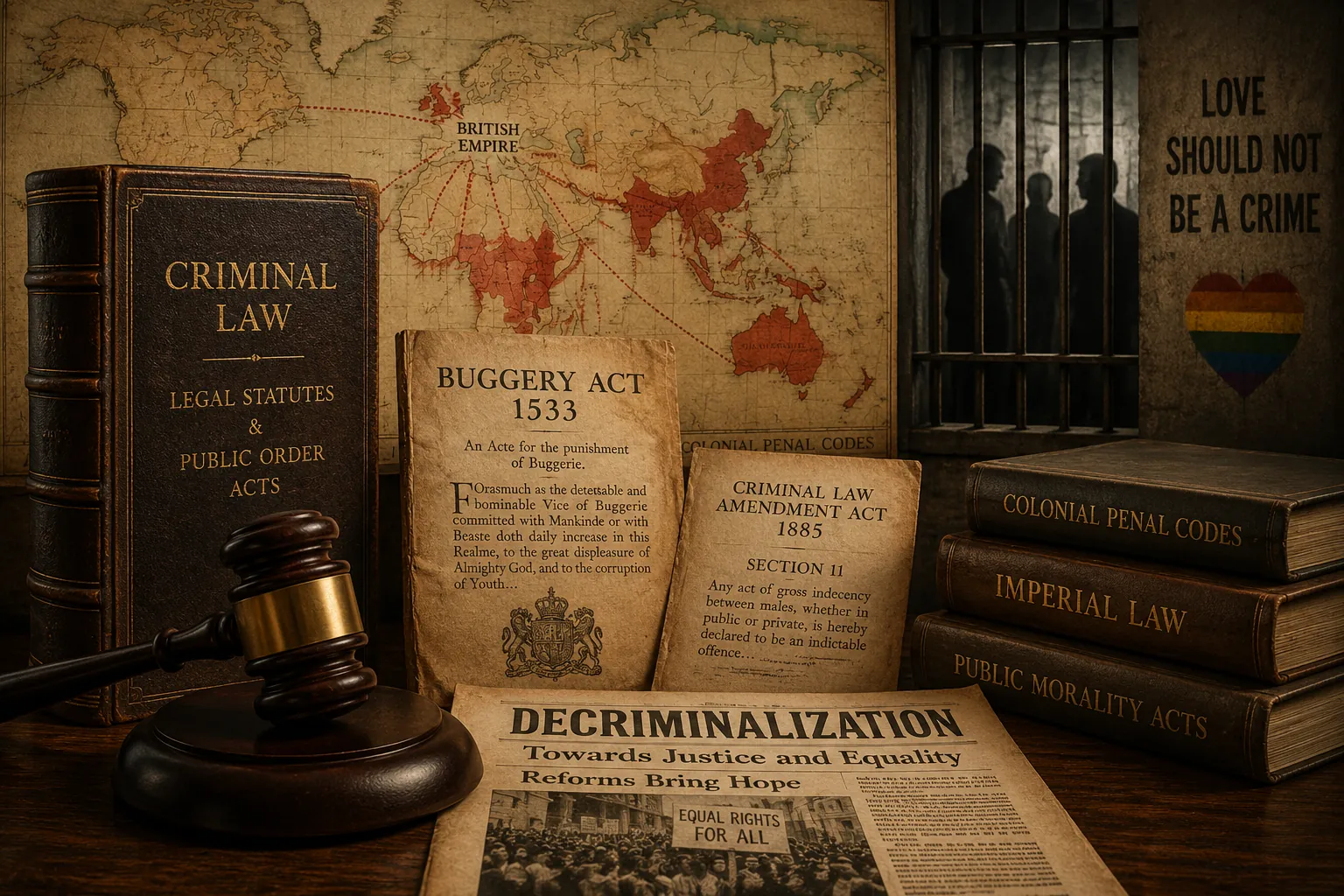 When did homosexuality become illegal?
There is no single date that answers the question for every country or civilization. Laws governing same-sex intimacy developed differently across societies, and many ancient cultures did not divide people into the modern categories of heterosexual, homosexual, bisexual, or transgender.
In some places, particular same-sex acts were punished. In others, they were tolerated under certain social rules. Some societies recognized forms of gender and sexual diversity that do not fit neatly within modern Western terminology.
The history of LGBTQ+ criminalization is therefore not the story of one law appearing at one moment. It is the story of religion, empire, social hierarchy, political authority, medicine, morality, and governments deciding which private relationships would be permitted—and which people would be punished.
Was Homosexuality Always Illegal?
No. Same-sex relationships were not always illegal, and attitudes toward them were never identical across the world.
Ancient societies understood sexuality differently from modern societies. In parts of ancient Greece and Rome, for example, the social status, age, citizenship, and expected role of each person could matter more than whether both partners were male.
This does not mean that the ancient world offered modern LGBTQ+ equality. Ancient societies contained strict hierarchies, unequal relationships, and strong expectations concerning masculinity, marriage, family, and citizenship.
However, the historical evidence makes one point clear: same-sex desire and gender diversity existed long before modern LGBTQ+ terminology.
Readers interested in that earlier history can also explore Did LGBTQ+ People Exist in Ancient History? What the Evidence Shows.
Ancient Laws Targeted Acts, Not Modern Identities
Modern people often think of homosexuality as an identity or enduring sexual orientation. Older legal systems usually focused instead on particular acts, social roles, or violations of religious and family expectations.
A law might prohibit a specific sexual act without defining an entire group of people as homosexual. A man could have relationships with both men and women without being placed into a permanent legal category equivalent to gay or bisexual.
This distinction is important because the word homosexual did not exist in the ancient or medieval world. It emerged during the nineteenth century as doctors, legal authorities, psychologists, and social theorists developed new systems for classifying sexuality.
The experiences themselves were not new. The modern categories used to describe those experiences were.
From Religious Prohibition to Criminal Law
Religious teaching strongly influenced European attitudes toward sexuality, but religious disapproval and state criminalization were not always the same thing.
During parts of medieval European history, conduct described as sodomy could fall under the authority of church or ecclesiastical courts. Over time, secular governments increasingly transformed religious and moral prohibitions into criminal offences enforced by the state.
This shift gave governments greater power to arrest, imprison, publicly shame, and sometimes execute people accused of prohibited sexual conduct.
It also illustrates an important historical pattern: private behaviour became a tool through which authorities could demonstrate religious legitimacy, enforce social conformity, or target unpopular individuals and groups.
England’s Buggery Act of 1533
A major turning point in English legal history came in 1533 during the reign of Henry VIII.
The Buggery Act brought the offence commonly called buggery into English secular criminal law. It did not create the modern legal category of homosexuality, and its language was not limited exclusively to consensual relationships between men. Nevertheless, prosecutions involving men became its most visible and historically significant application.
The offence carried the death penalty. Although enforcement varied over the centuries, the law established a powerful legal foundation for later punishments of male same-sex intimacy.
The death penalty for the offence was eventually removed in the nineteenth century, but decriminalization did not follow. Imprisonment replaced execution, and the legal reach of the state soon expanded further.
The 1885 Law That Expanded Prosecution
In 1885, Britain adopted Section 11 of the Criminal Law Amendment Act, commonly associated with Member of Parliament Henry Labouchere.
The provision made acts of “gross indecency” between men illegal whether they occurred in public or private. The wording was deliberately broad and did not require proof of the specific act covered by older sodomy laws.
That vagueness made the law especially dangerous. Private letters, testimony, surveillance, rumours, hotel records, or evidence of intimacy could be used against men suspected of same-sex relationships.
The provision became one of the most notorious instruments used to prosecute gay and bisexual men in Britain. Oscar Wilde was convicted under it in 1895. More than half a century later, it also formed part of the legal system that destroyed Alan Turing’s life.
Why Was Alan Turing Prosecuted?
Alan Turing was one of the most important mathematicians and codebreakers of the twentieth century. His work at Bletchley Park helped Britain and its allies decipher Nazi Germany’s encrypted communications during the Second World War.
Yet in 1952, British authorities prosecuted Turing for gross indecency after his relationship with another man became known to police.
He was forced to choose between imprisonment and hormonal treatment. He accepted the treatment, lost his security clearance, and was subjected to government supervision despite everything he had contributed during the war.
Turing’s prosecution demonstrates how anti-gay laws operated in practice. The law did not punish an abstract political position. It entered a person’s home, examined his private relationships, damaged his career, and altered the course of his life.
His full story is explored in Why Was Alan Turing Prosecuted for Homosexuality?.
How Colonial Empires Spread Anti-Gay Laws
One of the most important—and frequently overlooked—parts of LGBTQ+ legal history is the role of colonialism.
European empires did not simply control land and trade. They also exported legal codes, religious assumptions, systems of education, family policies, and definitions of acceptable behaviour.
The British Empire introduced criminal provisions against same-sex intimacy across territories in Africa, Asia, the Caribbean, the Pacific, and other regions. Colonial penal codes frequently used language concerning buggery, gross indecency, carnal knowledge against the order of nature, or offences against morality.
These laws were often imposed on societies that had their own established approaches to sexuality, gender, kinship, spirituality, and community roles.
After independence, many former colonies retained the criminal codes they had inherited. As a result, laws sometimes presented today as ancient local traditions may actually contain language and legal structures introduced by European colonial governments.
Religion Was Not the Only Cause
Religion played an important role in the history of sexual regulation, but it does not provide a complete explanation.
Governments also criminalized private conduct to enforce family structures, inheritance systems, gender roles, military discipline, population policies, and political conformity.
Authorities sometimes used accusations of prohibited sexuality to discredit opponents or justify surveillance. Police forces used morality laws to raid meeting places, entrap suspects, seize correspondence, and intimidate communities.
Medical institutions later added another layer of control by classifying homosexuality as illness, abnormality, or psychological disorder.
The criminal courtroom, religious institution, police station, and medical clinic did not always operate separately. Their ideas frequently reinforced one another.
Were Relationships Between Women Criminalized?
Many historic laws explicitly targeted sexual activity between men. This has sometimes created the misleading impression that relationships between women were accepted or ignored.
Women often lived under different forms of legal and social control. They could be punished through public-morality laws, family authority, forced marriage, confinement, loss of employment, institutionalization, or accusations unrelated to a specifically defined lesbian offence.
Women also appear less often in many surviving legal records because lawmakers frequently refused to acknowledge that sexual intimacy between women existed.
Legal invisibility was not the same as freedom.
Criminalization in the United States
In the United States, laws against sodomy developed through colonial and state legal systems. Their wording and enforcement differed across jurisdictions, but they remained tools for policing same-sex relationships well into the modern era.
Even where prosecutions were uncommon, the existence of these laws reinforced discrimination. They could be used to justify police harassment, employment restrictions, denial of custody, immigration decisions, exclusion from military service, and the closure or surveillance of LGBTQ+ gathering places.
In 2003, the United States Supreme Court decided Lawrence v. Texas. The ruling invalidated laws criminalizing private, consensual sexual conduct between adults of the same sex.
The decision did not instantly eliminate every form of discrimination, but it ended the constitutional legitimacy of criminalizing consensual same-sex intimacy in private.
Britain’s Partial Decriminalization in 1967
Public concern about the prosecution of gay men grew during the 1950s. In 1957, the Wolfenden Report recommended that private, consensual sexual activity between adults should no longer be a criminal offence.
Ten years later, the Sexual Offences Act 1967 partially decriminalized certain private sexual acts between men in England and Wales.
The reform was limited. It applied only under specific conditions, used an age threshold higher than the heterosexual age of consent, and did not initially extend to Scotland or Northern Ireland.
Scotland changed its law in 1980, and Northern Ireland followed in 1982 after a successful human-rights challenge.
Decriminalization was therefore a process rather than a single moment. Old convictions, unequal ages of consent, military restrictions, police practices, and social stigma continued long after the first legal reform.
Decriminalization Did Not Immediately Create Equality
Removing a criminal penalty does not automatically produce equal citizenship.
People who had been arrested or convicted continued to live with criminal records, damaged careers, family rejection, public exposure, and psychological harm. Many had learned that honesty about their relationships could cost them employment, housing, custody, security clearance, or freedom.
Governments also continued to regulate LGBTQ+ life through censorship, military rules, immigration policy, public-order laws, unequal ages of consent, restrictions on education, and the denial of relationship recognition.
Legal history therefore cannot be reduced to a timeline of repeal dates. The deeper question is how long the effects of criminalization remain within institutions and public attitudes.
Why Were These Laws So Powerful?
Anti-gay laws affected more than the people formally convicted under them.
The possibility of arrest encouraged secrecy. Secrecy created opportunities for blackmail. Fear of exposure discouraged people from reporting violence, seeking medical care, or challenging unfair treatment.
Criminalization also sent a wider social message. It told families, employers, schools, newspapers, police officers, and religious communities that LGBTQ+ people could legitimately be treated as dangerous, immoral, or unworthy of protection.
A law may appear to regulate one private act, but its cultural influence can reach far beyond the courtroom.
Why This History Still Matters
Arguments about sexuality are often presented as a conflict between modern LGBTQ+ identities and ancient traditions.
The historical record is more complicated.
Same-sex desire existed before modern identity labels. Some ancient societies tolerated forms of same-sex intimacy while imposing restrictions unfamiliar to modern readers. Religious teachings changed across time and place. Governments converted moral beliefs into criminal law. Colonial powers exported those laws, and later generations sometimes mistook them for timeless local traditions.
Understanding this complexity does not require readers to abandon their religious beliefs, cultural traditions, or personal values.
It does require separating historical evidence from political slogans.
A Human Story Behind the Law
Legal histories can become lists of acts, court judgments, and dates. Behind every statute, however, were real people.
Some lost their freedom. Some lost their work, families, reputations, or homes. Some entered marriages they did not want because living openly was impossible. Others resisted by forming friendships, communities, publications, organizations, and movements for reform.
The history of LGBTQ+ criminalization is ultimately a history of how societies decide who is permitted to belong.
Explore the Wider History of Sexuality and Gender
The Clash of Rainbows and Traditions: The Human Story of Sexuality and Gender Diversity by Adrian Solen examines the wider story behind these conflicts.
The book travels across ancient civilizations, religious traditions, scientific developments, colonial systems, criminal laws, cultural change, and personal experience.
Rather than treating history as a weapon against religious or LGBTQ+ communities, it asks how fear, tradition, identity, law, and the human need for belonging became entangled.
Understanding does not require agreement on every modern debate. But meaningful disagreement becomes possible only when history is approached honestly.
Discover The Clash of Rainbows and Traditions and explore the human history behind sexuality, gender, law, tradition, and belonging.
Frequently Asked Questions
When did homosexuality first become illegal?
There is no universal date. Different societies regulated same-sex conduct at different times. In England, the Buggery Act of 1533 was a major point at which prohibited sexual conduct was formally incorporated into secular criminal law.
Was homosexuality illegal in ancient Greece?
Ancient Greek societies did not use the modern legal categories of homosexual and heterosexual. Some same-sex relationships were known or permitted, but they were governed by rules concerning status, citizenship, age, gender, and social role.
Why did Britain criminalize homosexuality?
British criminalization developed from a combination of religious morality, social expectations, political authority, and state control. The laws initially targeted particular sexual acts and later expanded to broadly defined conduct between men.
How did anti-gay laws spread around the world?
European colonial powers, particularly Britain, introduced criminal codes against same-sex intimacy in many territories. Numerous former colonies retained these provisions after independence.
When was homosexuality decriminalized in Britain?
Certain private, consensual acts between men were partially decriminalized in England and Wales in 1967. Comparable reform occurred in Scotland in 1980 and Northern Ireland in 1982. Full legal equality required many additional reforms.
Why was Alan Turing convicted?
Alan Turing was convicted in 1952 because consensual sexual activity between men remained illegal under British law. His wartime service and scientific achievements did not protect him from prosecution.
Did decriminalization immediately create LGBTQ+ equality?
No. Criminal penalties were only one part of discrimination. Unequal ages of consent, military restrictions, censorship, employment discrimination, criminal records, and social prejudice continued after initial decriminalization.
No public comments yet
Be the first to share a thoughtful note. Approved comments will appear here.