Same‑Sex Relationships in Ancient Greece, China & Egypt
By Adrian Solen · Published September 30, 2026 · Approximately 5 minutes
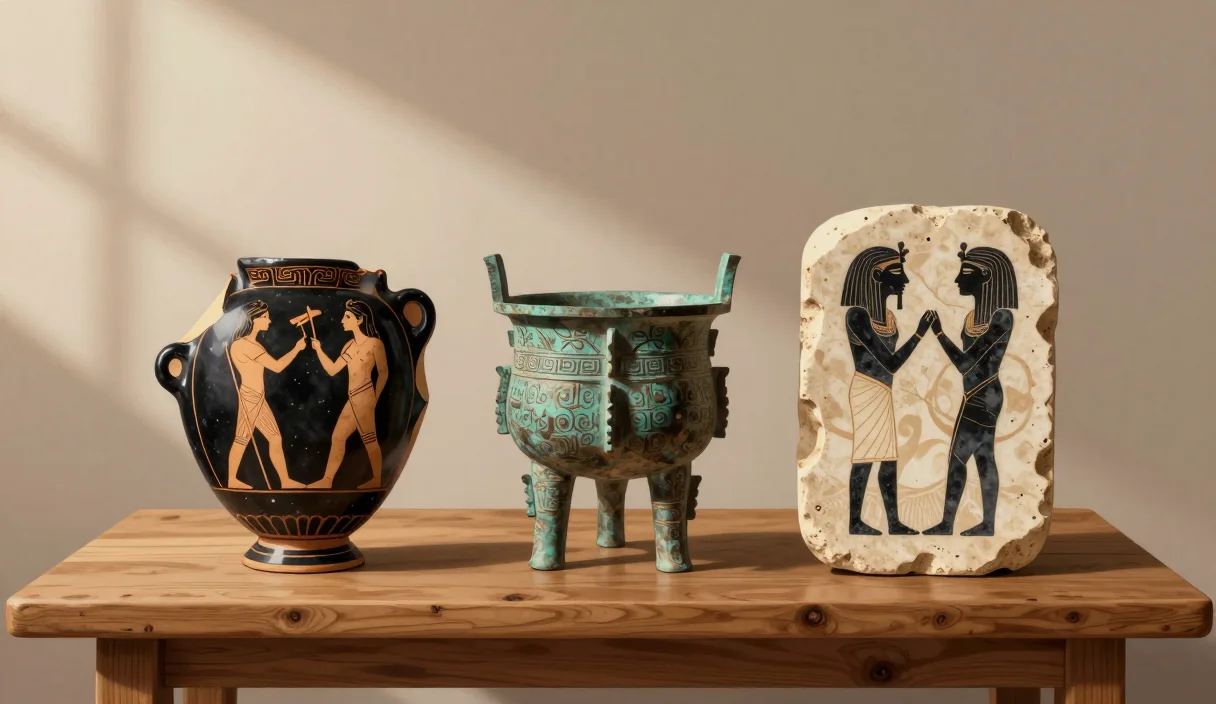
Same‑sex relationships appear throughout the ancient world, though they were understood in ways that differ from today’s categories. In classical Greece, poets and historians record emotional bonds between men such as Achilles and Patroclus, showing a mix of friendship, mentorship and erotic affection. Across Asia and Africa, tomb inscriptions and literary anecdotes also preserve memories of male couples, offering clues to how societies valued those ties.
Achilles and Patroclus relationship
Primary source excerpt – The Iliad records a deep bond between the hero Achilles and his companion Patroclus. While Homer does not label the relationship as sexual, later Greek writers such as Plato and Aeschylus discuss it in terms that allow both friendship and erotic interpretation.
Archaeological / literary evidence – Vase paintings from the 5th century BC show Achilles and Patroclus together, sometimes with one figure bearing a beard while the other is clean‑shaven, reflecting ancient debates about who was erastes (active) and who was eromenos (passive). Plato’s Symposium and later scholiasts treat the pair as exemplars of heroic male love.
Scholarly interpretations – Kenneth Dover argues that adult Greek men could only occupy an active role without stigma; the passive partner risked being labeled feminized. Some scholars, citing Xenophon’s Symposium, see Achilles and Patroclus as a model of ideal same‑sex friendship rather than a normative sexual practice. Others point to the Sacred Band of Thebes as evidence that societies sometimes valorised male lovers in military contexts.
What this tells us about ancient attitudes: The relationship was widely known and discussed, but its moral evaluation depended on role expectations. Active dominance was praised; receptive participation could attract ridicule. Nonetheless, emotional intimacy between men could be celebrated as a source of courage and loyalty.
The Cut‑Sleeve story (Han China)
According to the Book of Han, the emperor cut off his sleeve rather than wake his sleeping companion Dong Xian.
Primary source excerpt – The tale of Emperor Ai and his male lover Dong Xian appears in the Book of Han (Hanshu), describing how the emperor cut off a sleeve rather than wake his sleeping companion.
Archaeological / literary evidence – The Book of Han (Hanshu), a 1st-century AD dynastic history, records Dong Xian’s rapid rise and the emperor’s public displays of affection, such as granting him high office.
Some scholars note that while Confucian texts emphasize hierarchical propriety, they also record instances where same-sex affection was tolerated, especially when the lover occupied a subordinate yet favored position. The Cut‑Sleeve anecdote has become a cultural idiom for male love in later Chinese literature.
What this tells us about ancient attitudes: In Han China, affectionate relationships between men could be publicly acknowledged when they reinforced loyalty to the ruler. The moral framing was less about gendered sexuality and more about hierarchical order; affection that respected rank was socially permissible.
Khnumhotep & Niankhkhnum (Old Kingdom Egypt)
The most famous scene shows the two men standing close to each other and embracing.
Primary source excerpt – The limestone tomb at Saqqara (circa 2450–2400 BC) bears an inscription naming Khnumhotep and Niankhkhnum together, with a scene showing them embracing.
Archaeological / literary evidence – The joint mastaba includes reliefs of the pair sharing food, walking arm‑in‑arm, and attending to each other’s personal grooming. No contemporary Egyptian text explicitly labels their bond, but the intimacy depicted is comparable to that shown for married couples elsewhere in Old Kingdom art.
Scholarly interpretations – Some scholars, such as Greg Reeder, have argued that the tomb may represent a same‑sex couple; others suggest the figures could be brothers or twins. the rarity of two men sharing a burial and the affectionate pose. Others caution that the scene could represent close friendship or brotherhood, noting that Egyptian texts rarely discuss sexual categories.
What this tells us about ancient attitudes: Some scholars interpret the willingness to allocate a shared tomb as indicating intimate male partnerships among elite officers, while others view it as reflecting kinship or brotherhood; the lack of explicit moral commentary means we cannot conclude whether such bonds were socially accepted or contested, and modern labels cannot be retroactively applied.
Frequently Asked Questions
What does the Iliad say about Achilles and Patroclus?
The Iliad records a deep bond between the two heroes, describing their loyalty and grief. Later Greek writers interpreted this closeness as either heroic friendship or erotic love, but the epic itself leaves the exact nature open.
How was homosexuality viewed in ancient China?
In Han‑Dynasty records, same‑sex relationships among court officials were noted without moral condemnation, especially when they reinforced loyalty to the emperor. The famous “Cut‑Sleeve” anecdote became a cultural reference for male affection.
What evidence exists for homosexuality in ancient Greece?
Greek literature—poems, plays, and philosophical dialogues—frequently discusses pederastic bonds and adult male love. Vase paintings, legal references, and historical accounts such as those of the Sacred Band illustrate both acceptance and stigma depending on social role.
Did same‑sex relationships exist in ancient Mesopotamia?
Legal codes like the Code of Hammurabi do not mention consensual male–male relations, and surviving literature offers few explicit references. Scholars therefore note that evidence is sparse and interpretations remain tentative.
What does Roman law say about same‑sex relationships?
Roman attitudes distinguished active (dominant) from passive (submissive) roles. Freeborn men could engage with slaves or prostitutes in the active role without legal penalty, while assuming a receptive position risked social disgrace.
Are there same‑sex couples depicted in ancient Egyptian art?
The joint tomb of Khnumhotep and Niankhkhnum at Saqqara shows two men embracing and sharing food, which some Egyptologists interpret as a representation of an intimate partnership.
No public comments yet
Be the first to share a thoughtful note. Approved comments will appear here.