LGBTQ+ NonFiction Book Histroy Gender Studies
Looking for an LGBTQ nonfiction book that brings together history, gender studies, sexuality, culture and personal understanding? Discover a compassionate guide written for adults, allies, families, students and curious readers.
By Adrian Solen · Published July 24, 2026 · Approximately 5 minutes
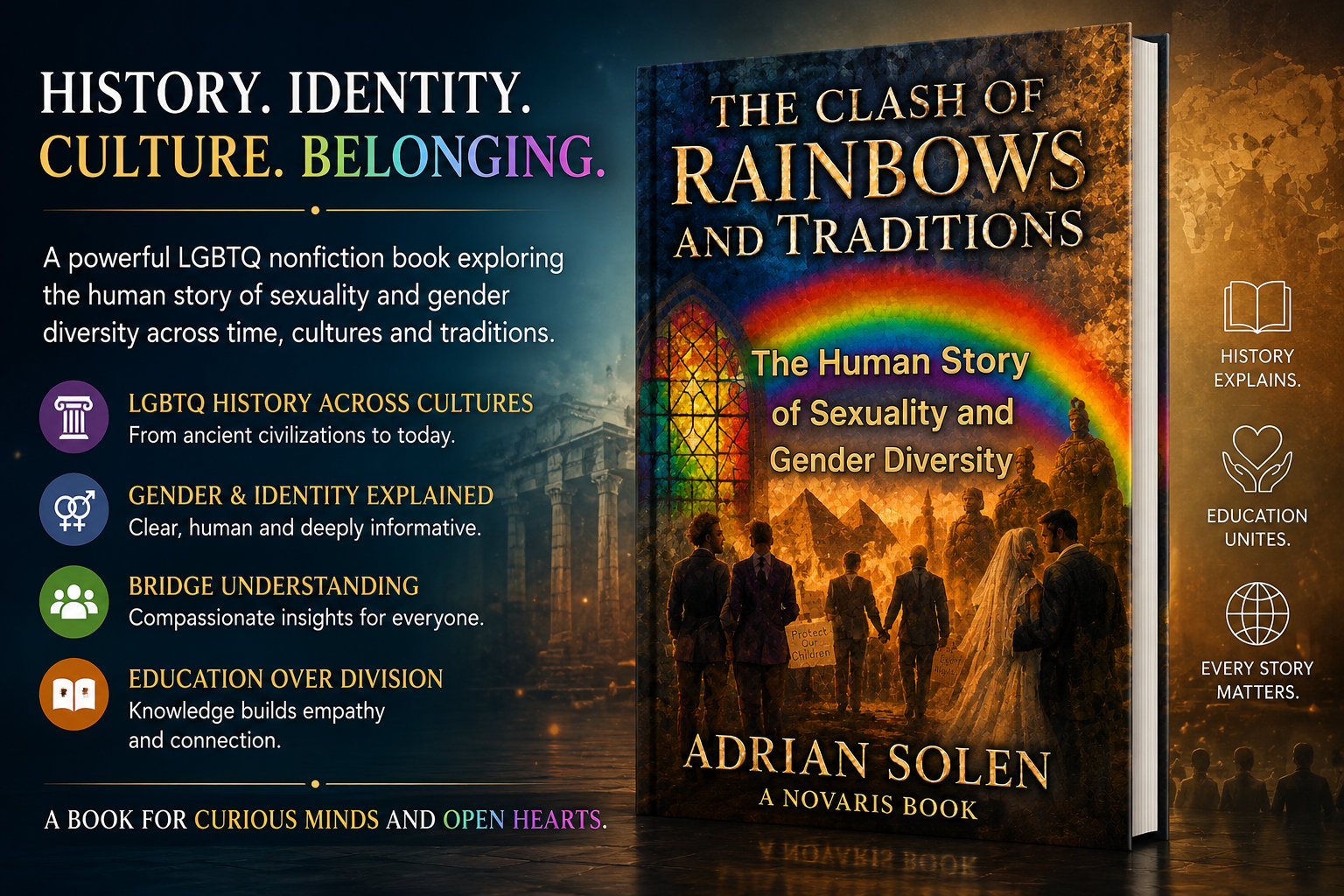
Looking for an LGBTQ Nonfiction Book? Explore History, Gender, Sexuality and Belonging
Finding the right LGBTQ nonfiction book can be surprisingly difficult.
Some books concentrate on one historical period. Others examine gender identity, sexuality, politics or personal experience separately. Academic gender studies books can provide valuable research, but they may feel too specialized for readers who are new to the subject.
Many people are searching for something more complete: a book that explains how history, culture, science, identity and human experience connect.
The Clash of Rainbows and Traditions by Adrian Solen was written for those readers.
This wide-ranging work of narrative nonfiction explores the long and complicated relationship between sexuality, gender, culture, religion, tradition and belonging. Rather than presenting the subject as a battle between opposing groups, the book encourages readers to understand how different perspectives developed—and why education can change the way people see one another.
More Than an LGBTQ History Book
An LGBTQ history book should do more than list important dates and political events. It should help readers understand the people, beliefs and social pressures behind that history.
The Clash of Rainbows and Traditions takes readers across different periods and civilizations, examining how societies have understood sexuality and gender in very different ways.
The journey moves from the ancient world through religious and political transformations and into the modern struggle for recognition, equality and personal freedom. It also introduces traditions and identities from cultures beyond the familiar Western narrative.
By placing modern discussions within a much larger historical context, the book helps readers see that questions about sexuality, gender roles and identity did not suddenly appear in the twenty-first century.
They are part of a much older human story.
For readers searching for a queer history book, an LGBTQ culture and history book, or an accessible introduction to the history of gender and sexuality, this broader approach provides valuable context.
A Gender Studies Book for General Readers
Many people are interested in gender studies but do not want to begin with a dense university textbook.
They may be asking:
What is the difference between sex, gender identity and sexual orientation?
How have cultures defined masculinity and femininity?
Why do different societies respond so differently to LGBTQ identities?
How much of identity comes from biology, culture, family, religion or personal experience?
Why have discussions about gender and sexuality become so politically and emotionally charged?
A good gender studies book for beginners should explain these questions without assuming that the reader already understands specialized terminology.
The Clash of Rainbows and Traditions introduces key concepts in a clear and approachable way while connecting them to history, culture and lived experience. It can therefore serve as a useful nonfiction gender studies book for readers beginning their exploration of the subject.
The purpose is not to tell readers what they must think. It is to provide the historical background, definitions and human stories they need to think more carefully.
Understanding Sexuality and Gender Identity
Readers looking for a book about sexuality and gender identity are often searching for more than definitions.
They want to understand what these concepts mean in real life.
Sexual orientation describes patterns of emotional, romantic or sexual attraction. Gender identity concerns a person’s internal understanding of gender. Gender expression involves the ways people communicate identity through appearance, behaviour or social roles.
Although these ideas can be explained separately, human experience is rarely divided into simple categories.
Family expectations, religious beliefs, cultural traditions, community pressure and personal discovery can all affect how people understand themselves and others.
That is why the book approaches identity as both a personal and social experience. It examines terminology, history and science while never losing sight of the human beings behind the discussion.
For readers interested in gender identity nonfiction, sexual orientation and gender identity, or an educational book about LGBTQ experiences, this combination of explanation and storytelling makes difficult subjects easier to approach.
Who Should Read This LGBTQ Nonfiction Book?
Readers Interested in History and Social Change
History readers will find a broad examination of how ideas about gender and sexuality have changed across civilizations and historical periods.
The book also explores what happens when political power, law, medicine, religion and social customs attempt to define acceptable identity and behaviour.
Parents and Family Members
Parents may genuinely love their children while struggling to understand unfamiliar language or experiences.
For someone searching for LGBTQ books for parents, this book offers background and context without treating uncertainty as hatred. It encourages families to replace fear and assumptions with education, communication and empathy.
Friends, Colleagues and Allies
Many people want to support LGBTQ individuals but feel unsure about terminology or worried about saying the wrong thing.
Readers searching for LGBTQ books for allies can use this book to build a stronger foundation of historical and cultural understanding.
Being an ally does not require knowing every answer. It begins with a willingness to listen and learn.
Students and Educators
Students studying history, sociology, culture, diversity, sexuality or gender may find the book useful as a broad introduction to interconnected subjects.
Educators may also use its themes to encourage respectful conversations about how societies create traditions, how those traditions change and how education influences public attitudes.
Book Clubs and Discussion Groups
The book is particularly suited to groups interested in social questions that do not have simple answers.
Its combination of history, science, culture and personal experience can support conversations about identity, belonging, prejudice, tradition and social change.
Readers Who Feel Caught Between Two Sides
Public discussions about LGBTQ issues are often presented as a choice between complete agreement and complete rejection.
Many readers do not see themselves at either extreme. They may support human dignity while still having questions about culture, religion, terminology or modern politics.
This book creates room for those readers.
It recognizes that understanding develops gradually and that respectful education is often more effective than accusation.
A Book About Education, Not Division
The central idea behind The Clash of Rainbows and Traditions is that knowledge can change perspective.
People often inherit opinions before they have the opportunity to examine them. Those opinions may come from family, religion, community, political movements or personal experiences.
Education does not require a person to abandon every belief or tradition. It asks them to examine those beliefs alongside history, evidence and the experiences of other human beings.
That approach is especially important when discussing sexuality and gender.
Behind every label is a person who wants many of the same things others want: safety, dignity, love, family, purpose and a place to belong.
By connecting historical knowledge with human experience, the book encourages readers to move beyond slogans and consider the consequences that laws, customs and social attitudes can have on real lives.
Why Cultural Context Matters
Gender and sexuality are often discussed as though every society understands them in exactly the same way.
The reality presented throughout the book is more complex.
Different cultures have developed their own identities, social roles, expectations and traditions. Some recognized forms of gender diversity, while others enforced strict divisions. Some tolerated same-sex relationships in particular circumstances, while others punished them.
Understanding this cultural variation helps readers avoid treating one society’s experience as the complete history of humanity.
It also makes The Clash of Rainbows and Traditions relevant to readers searching for a diversity and inclusion book, a cultural study of gender, or a global introduction to LGBTQ history.
Is This an Academic Textbook?
No.
The book examines subjects commonly discussed in history, sociology, sexuality studies and gender studies, but it is written for general adult readers.
It uses an accessible narrative style rather than presenting the material as a collection of academic lectures. Historical context, scientific explanations and human stories are brought together to create a connected reading experience.
Readers do not need previous knowledge of LGBTQ terminology or gender studies to begin.
Curiosity and a willingness to consider different perspectives are enough.
What Makes This Book Different?
The Clash of Rainbows and Traditions does not examine LGBTQ history, gender identity, sexuality, religion and culture as isolated subjects.
It explores the connections between them.
The book asks why certain beliefs became traditions, how those traditions influenced laws and social attitudes, and what happens when individual identity conflicts with community expectations.
It also avoids reducing people to political categories.
LGBTQ individuals are presented as human beings rather than symbols. Religious and traditional communities are treated as diverse groups rather than stereotypes. Readers who are still learning are invited into the conversation instead of being automatically condemned for having questions.
This bridge-building approach makes the book suitable for readers on many different parts of the social and political spectrum.
Choosing the Right LGBTQ Book for Adults
When comparing LGBTQ books for adults, consider what you hope to understand.
A memoir may provide a deeply personal story.
A political book may concentrate on laws and activism.
A historical study may examine a specific country or period.
A gender studies textbook may provide theoretical and academic analysis.
The Clash of Rainbows and Traditions is designed for readers who want these subjects placed within one larger human narrative.
It is especially appropriate for readers interested in:
- LGBTQ history across cultures
- Sexuality and gender identity
- The relationship between religion and identity
- The influence of tradition on social attitudes
- The science and language of identity
- Historical discrimination and social change
- Family acceptance and cultural conflict
- Education as a path toward understanding
- Respectful conversations between different communities
A Starting Point for Better Conversations
One book cannot resolve every disagreement surrounding gender and sexuality.
It can, however, improve the quality of the conversation.
Knowledge helps readers recognize oversimplification. History reveals that social beliefs change. Personal stories remind us that public debates affect individual lives.
Most importantly, education can create space for empathy without demanding that every reader begin from the same position.
For anyone searching for an LGBTQ nonfiction book, an accessible gender studies book, or a thoughtful introduction to LGBTQ history, The Clash of Rainbows and Traditions offers a place to begin.
Discover The Clash of Rainbows and Traditions
Written by Adrian Solen and published by Novaris, The Clash of Rainbows and Traditions is a nonfiction exploration of sexuality, gender, history, culture and belonging.
It was created for readers who want to understand how the past shaped today’s conversations—and how knowledge can help bridge the distance between people with different experiences and beliefs.
Explore The Clash of Rainbows and Traditions and begin a wider journey through LGBTQ history, gender studies and the human search for acceptance.
Frequently Asked Questions
What is a good LGBTQ nonfiction book for beginners?
A useful beginner-friendly LGBTQ nonfiction book should explain important terminology, provide historical context and remain accessible to readers without previous academic knowledge. The Clash of Rainbows and Traditions combines history, culture, gender studies and human stories for general adult readers.
Is there a book that explains both LGBTQ history and gender identity?
Yes. The Clash of Rainbows and Traditions examines LGBTQ history alongside sexuality, gender identity, cultural traditions, religion, science and social change.
Who should read a nonfiction gender studies book?
Gender studies nonfiction can be valuable for students, educators, parents, allies, book clubs, history readers and anyone interested in understanding how societies shape ideas about gender, sexuality and identity.
Is this book only for LGBTQ readers?
No. The book is written for LGBTQ readers and for people who want to understand LGBTQ experiences, including family members, friends, educators, allies and readers approaching the subject for the first time.
Is this an LGBTQ book for parents and families?
It can help parents and family members understand terminology, history, identity and the pressures LGBTQ people may experience. Its bridge-building approach is intended to encourage learning and respectful communication.
Does the book discuss religion and traditional beliefs?
Yes. The book examines how religion, cultural expectations and traditional values have influenced attitudes toward sexuality and gender while encouraging respectful consideration of different perspectives.
Is this a textbook or an academic gender studies book?
It covers subjects connected to gender studies, history and social science, but it is written as accessible narrative nonfiction rather than as a formal academic textbook.
Where can I find a book about sexuality, gender and belonging?
The Clash of Rainbows and Traditions is available in digital and print formats and can be explored through the official Novaris Books website and Amazon.
No public comments yet
Be the first to share a thoughtful note. Approved comments will appear here.